Chinese symbol for good luck
The Chinese symbol for good luck is 吉 (jí), auspicious, the same in simplified and traditional writing. For a phrase, choose 吉祥 (jí xiáng), 如意 (rú yì), or 吉祥如意. Duane checked this reading. The picture is a sample stencil, not a design made for your own words, but feel free to download it if it suits your needs.
Characters
Simplified is mainly used in mainland China and Singapore. Traditional is used in Taiwan, Hong Kong, and classic Chinese calligraphy, including Ou style (歐體). Readers in all these places generally recognize either.
For this word, the simplified and traditional forms look the same.
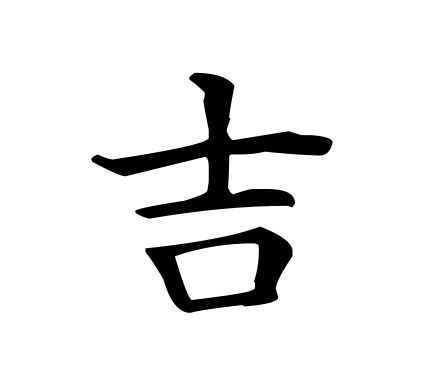
Simplified and traditional look the same here.
Classic uses 汇文正楷 (Huiwen Zhengkai). It is a modern font copied from 汉文正楷 (Hanwen Zhengkai), a regular script (楷书) metal type used to print books and papers in China in the early 1900s. It was copied from a printed sample sheet of the small size of that type. The slightly rough edges and small nicks are marks of that old printing, not mistakes. Smooth uses LXGW WenKai, a newer font with clean edges. Prefer smoother strokes? Choose Smooth, or just ask.
This sample uses 汇文正楷 (Classic) or LXGW WenKai (Smooth), both regular script (楷书) fonts. Both are in the same brush-style family as the 欧体 Duane has practiced since childhood, but neither is 欧体 and neither is his own brush writing. Want it closer to classic 欧体 calligraphy? Choose Hand-brushed by Duane in the form.
Meaning
吉 means auspicious, a sign of good fortune. It is simple and elegant on skin. If you prefer a phrase, 吉祥 (jí xiáng) means auspicious and blessed, 如意 (rú yì) means things go as you wish, and 吉祥如意 joins the two. All look the same in simplified and traditional writing.
Common mistakes
好运 (traditional 好運) reads like a casual 'good luck!' wish, not a lasting symbol. 福 is the answer many translators give, and it is not wrong. But 福 is pasted everywhere on New Year doors, displays, and couplets, so on the body it can look like a holiday decoration and feel inelegant. 吉 is more elegant on skin.
Also check the final stencil before you ink: a flipped (mirrored) character, a look-alike with one stroke changed, or a whole English sentence put through a machine translator are the mistakes Chinese readers spot first. See how to avoid a wrong Chinese tattoo.
Before you tattoo this
Say whether you want one character (吉) or a phrase (吉祥, 如意, or 吉祥如意).
Want this in your own words or name? Tell Duane the meaning you're after.
Checked by Duane, who grew up in China and lives in Ottawa. About Duane. Reviewed .